Friday, February 14, 2020

Signal Electric M100, sorta...

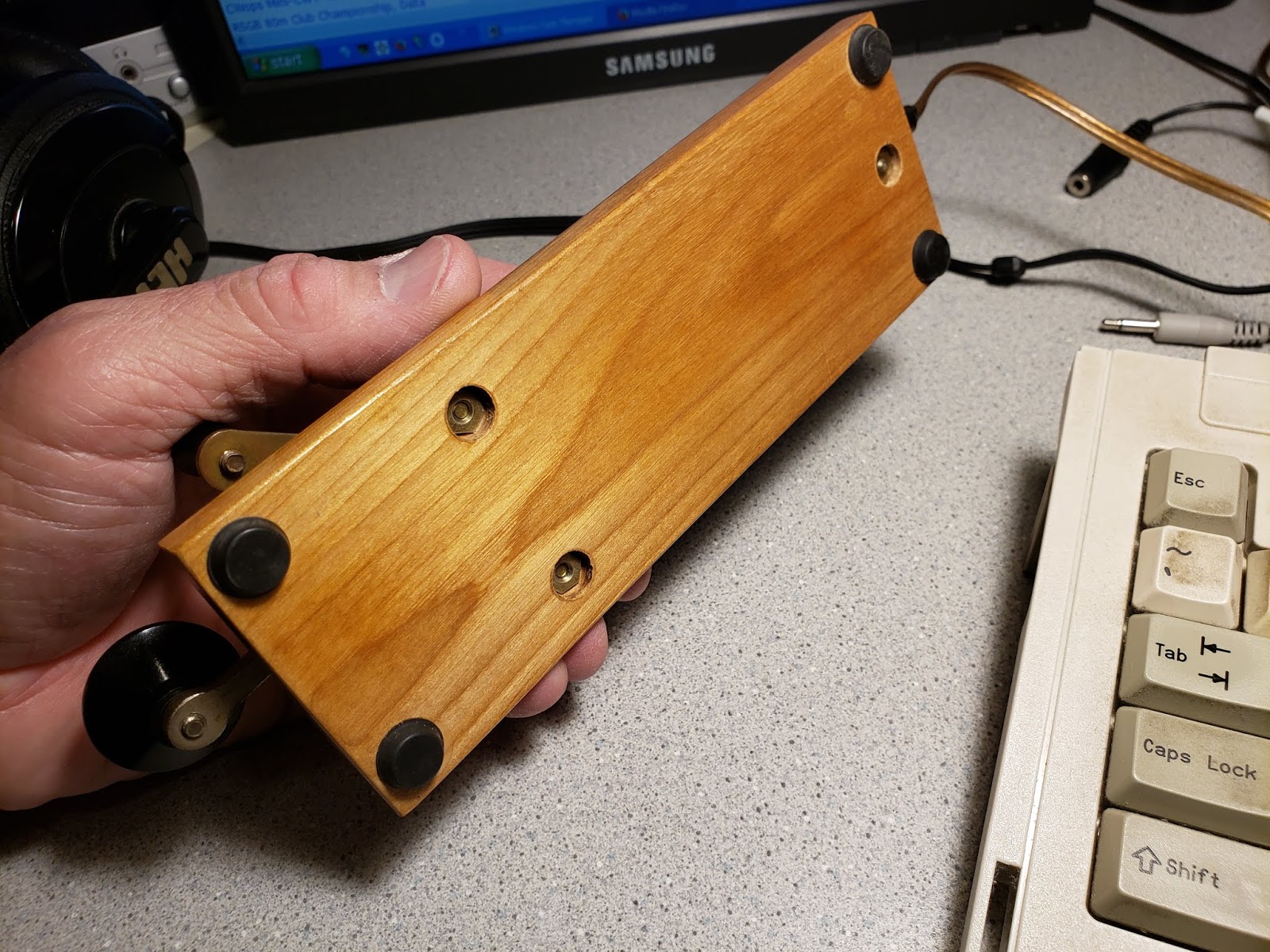
This is the best handling straight key I have in the shack. It's a Signal Electric M100, and was made somewhere around 1939-1941, as best as I can tell from markings and catalog info. This one is equipped with a leaf spring, instead of the typical coil spring, and I've not been able to find any of the Signal Electric "J-38" style keys like that...so I'm a bit baffled by that part. If it was converted by someone, they did a great job: the lever spring force feels perfect and is very easy on the wrist. 

I've not tried to clean it, other than to brush the dust off of it. It looks to be all solid brass (not brass plated steel, as it's non-magnetic), with a plated steel lever and flat top knob. 

Signal Electric M-100 with leaf spring...


Close up shot of the leaf spring setup...


This leaf spring arrangement is a mystery to me, but it works great!

You can faintly see the "SIGNAL ELECTRIC MFG CO. MENOMINEE, MICH" markings in base, under the "up" adjusting screw contact point.


Dave WB4IUY


Wednesday, February 12, 2020

Storm Damage, 2/6/2020

I had a little storm damage to the tower mounted antennas on 2/6/2020, though only a small amount. My tower is 105' tall, and the yagi antennas are mounted on top of that. The lowest antenna is the 6el Force-12 HF yagi, the middle yagi is the Cushcraft a50-5S 5el 6 meter yagi, and the top yagi is a Cushcraft 13B2 2m SSB yagi. 

We have had a weird winter...warm and wet. This is normally the time of year where we have temps in the low teens and the largest snowfalls. This year, we've barely run the home heating system, with lots of days in the 50's, 60's, and even 70's...and lots of rain. On this day, the temps started off in the 70's, fell about 20 degrees, and tremendous winds blew through. Rain storms were reported at moving over 100 mph (!!) by the local weather station, and there was lots of wind damage. We had loads of tree limbs down, but the damage in the photo below is the only antenna damage I had. The Force-12 at 105' was twisted on the vertical mast, the 6m 5 element yagi had a little damage to the reflector, and the tower mounted dipoles for 80 & 160 had a limb hanging on them. That's all! I'll take that any day, compared to the storm damage in 2016 that took the tower down :-)


Dave WB4IUY
www.WB4IUY.net


Monday, February 10, 2020

Portable Radio for RENT!

Boy, have times changed! This was supposedly a profitable business, back in 1948. Check out this cover from Radio News, May 1948...


Dave WB4IUY
www.WB4IUY.net


Sunday, February 9, 2020

Heathkit SB-220 Repairs

This is a few pics of a Heathkit SB-220 amp I repaired for a friend. It had a basket full of problems...HV supply was dropping voltage intermittently, band switch arcing, tuned input problems, bias issues, and more. These amps are real workhorses when in good operating condition. Here's a few pics and info on what was wrong with this beast.  

This amp was a mess....I started by breaking it down, and I prefer to work on it with the high voltage safety defeated. DO NOT do this...it's very dangerous, and the voltages / current available in this power supply can easily kill you! 

I pulled out my vintage high voltage probe to poke around in the HV supply...

I started right off by pulling and replacing a bunch of bad parts. Voltage divider resistors from the metering curcuit, RF choke from the grid circuit, blown LV filter cap...

One of the filter caps had literally blown the terminal right off the cap!

You can see the black area around the filter cap terminal in the upper LH filter bank...

I had to use my resistance substitution box to calibrate the HV meter function, those resistors were so far off and the original values didn't really bring the meter into calibration. 

I replaced the bad cap and all of the bleeder resistors. All caps should have been replaced, but I had to stay in the owner's budget. 

The HV curcuit is now working correctly and the meter is in calibration. 

Using the HV probe to double check the supply voltage.


Tweaking the metering circuit to read correctly...

One of the tubes would loose the filament connection from time to time....


The paracytic suppressors and plate connections were also a mess...coating popped off of the resistors in spots, some nasty braid used in the plate circuit, etc. I ripped all that junk out and rebuilt it...

 Winding new coils to install on a pair of new carbon film resistors for plate suppressors...


Plate suppressors all finished and installed...

Warming up and ready to test bias...

Added some silicon diodes to the bias string to get the bias current where it should be. 

Applied a little drive, and found the tuned input to be all buggered up...

Had to remove the front panel to get to the tuned input. One of the silver mica caps was exploded, most always due to over drive. No telling what had been driven into this amp by a previous owner...

Band switch wafer repaired (was arcing) and bad tuned input caps were replaced.

Band switch wafer had arcing contact, way down there. Another tough one to get to for repairs!

I discovered one of the tube filament pins were not making good contact in the tube socket. I removed the springs, cleaned the pin clamps, and resprung the clamping mechanisms. 


The metering switch was also broken. This is the replacement switch I installed...

This is the wafer from the broken metering switch...

 While cleaning up, I removed the knobs and with a little Windex and toothbrush I gave them a good cleaning.


 Driving the amp from a Yaesu FT-101 for testing...

Here it is, all cleaned up and ready to go. This was one of those projects, where the more things you repair, the more stuff you find that needs attention. It has had a rough life and problems were ignored at some point, but now it's back up to speed and running quite nicely. 

Dave WB4IUY
www.WB4IUY.net


Saturday, February 8, 2020

Speed-X Key, looking the model #...


This is an old Speed-X straight key that was given to me many years ago by friend and ham Peter N4SXG (now SK). It doesn't handle very good, but it is usable. I use it from time to time, and on straight key night, as it does have a special meaning to me. 

I am trying to find an approximate date of mfg, and the model #, if anyone out there should know what it is. It looks like the little cheapie plastic base unit that was sold by MFJ, Radio Shack, Ameco, etc....with a couple of exceptions. Those are:


It has Speed-X embossed into the lever...


It has Speed-X molded / raised in the plastic base, as well as a small raised rib in the base all the way around it's perimeter.  


Pete made a wooden base for it and installed some felt on the bottom of it. When he was alive, he only worked a straight key, and could really hammer this thing. Pete was a Navy CW op and copied on a mechanical typewriter.


Dave WB4IUY
www.WB4IUY.net