
The one thing almost every radio amateur needs is a 12vdc power supply. They're great for powering radios & projects in the shack. There are many various brands on the market that are ready to 'plug-n-play'. I never seem to have enough of these things for the shack and home workshop...
Most of us have junk home computers that have been pulled out of service, know someone who has this stuff, or see them at ham fests & swap meets for cheap/free. I had seen lots of little bits of information scattered around the web on the conversion of old computer power supplies for use as a 12vdc bench supply. These are typically light weight switch-mode designs, and can produce a tremendous amount of power for their size. The typical 250w supply can generate a solid 20+ amps of clean, well regulated power, and only takes a little work for the conversion.

You'll need a few basic bits to make this project work. All of this is easily found at Radio Shack, in junk radios, etc. You need a nice set of black & red binding posts to mount on the power supply for your external connections, a resistor of between 3 and 5 ohms @ 20 watts or more, a 270 ohm 1/2 watt resistor, a LED to mount through the cover to show "on", a couple of solder-type terminal strips, and a SPST toggle switch rated at about 2 amps or more.
I started this project with an old junker 250w power supply I pulled from a donor computer. The first order of business is to clean it well...these supplier are dust magnets and usually full of lint and dust. I opened this one up and blew it out with compressed air, and made sure to clean the fan as well.
Next, we need to group all of the wires together by color. I start by cutting the connectors off of the ends of the wire bundles. There are several wires that are black, orange, yellow, red, green, and grey. You may find some other colors, they won't be used, so go ahead and cut those out. You'll remove all of the orange wires, they are for a 3.3 vdc circuit that will not be used. If I can get to the bottom of the circuit board easily, I like to desolder them. Othersize, insulate the ends and pack them away, or clip them off at the board. Remove all but 1 of the red wires. Remove all but 5 of the black wires, and all but 3 of the yellow wires.

Now, it's time for a quick test of the supply. Connect your 3 to 5 ohm loading resistor between the red wire and one of the black wires. This fools the supply into thinking it is plugged into a motherboard. Connect the toggle switch between the green wire and a black wire and make sure it is open (off) with an ohmmeter. Connect the grey wire to the anode of your LED (usually the long lead), and the other side of your LED (cathode) through the 270 ohm resistor to one of the black wires. Connect a DC voltmeter to one of the yellow wires and one of the black wires. Make sure none of the other wires or touching each other or the metal case of the power supply. BE CAREFUL, LEATHAL voltages are present...plug the AC line cored into the power supply, and flip your toggle switch "ON". If all went well, you'll measure about 12 vdc between the yellow wire and the black wire. Great! Now, power everything down, disconnect the AC line cord, and wait about 10 minutes for the caps to discharge.
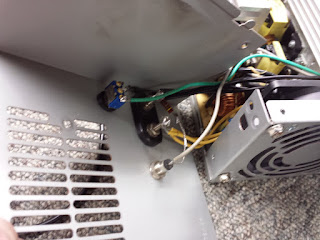
Let's mount some hardware! Pick a spot on the case or cover the you can mount your binding posts, switch and LED without it coming in contact with the internals when assembled. You'll also need to find somewhere to put the 3-5 ohm 20w resistor that you have connected to a red & black wire. I like to install a couple of terminal strips to mount the resistor so it is suspended for a little air cooling. You can see what I did in the photo, but since there are a zillion variations on the internal layout of these things, you can get very creative here. In the next photo you'll see where I mounted the binging posts, LED, and switch in this conversion. Some folks like to install fuse holders, but since all of my projects and gear have inline fuse holders, I don't bother with it.
You'll bundle 3 yellow (+12v) and 3 black (-) wires together, and connect them to the red and black binding posts. If you clip these wires to only the length needed, you'll fine that 3 conductors are ample for 20 amps of load current. The black wires should be connected to the black post, and the yellow wires should be connected to the red posts. You can use more wires if it makes you feel better, but I've tested a lot fo these and have never measured any significant voltage drop at well over 20 amps.

Put it all back together and make one final test. You'll need to always make sure the power switch is "OFF" before you plug the supply into AC, because a safety circuit in many of them will not let the supply power up if the power circuit is "ON" when the AC is connected. I test these with a simple load made of a string of parallel connected conventional light bulb sockets with a string of 50w 12dv RV lamps. I tested this supply at 25 amps continuous for 15 minutes and it barely got warm, and the difference in voltage between watts of load (4.16 amps) & 300 watts (25 amps) was less than .2 vdc.
One side note...while I can't speak for all of these supplies, I've intentionally blown several by overloading to witness the end result. In every test, the output simply dropped to 0 vdc, so I've never bothered to add a crowbar circuit like found in most linear supplies.
I hope this helps some of you build a few 12vdc supplies for your shack or workshop!
Dave WB4IUY
www.WB4IUY.net


