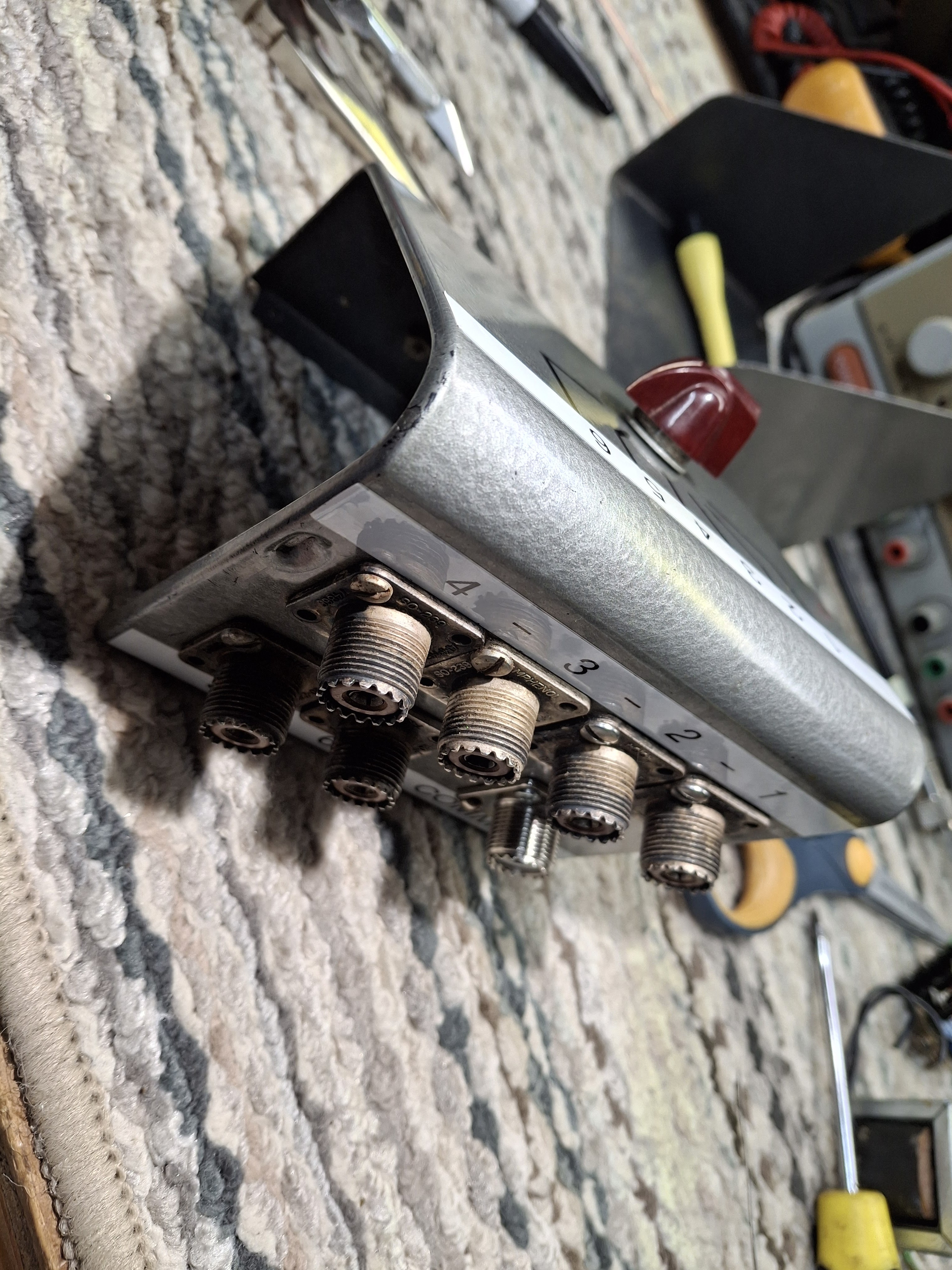
I had a need for a switchbox, to select between a number of low power radios... mostly boatanchors. Digging through the junkbox, I found a metal enclosure that was originally built as a multi-load t/r switch. I gutted it, made some changes, and whipped this up for $0. It now uses a non-grounding ceramic switch, and can select between 6 rigs, and has about 50dB of isolation on HF.
I've been in Amateur Radio since 1974, and still find new and interesting things to do. I like to build, restore, and operate on the air. This blog has been running for many years, so be sure to check out "Jump to Posts on Specific Topics" in the RH column to drill down and find lots of stuff. Visit www.WB4IUY.net, email to wb4iuy@gmail.com, or leave comments here directly on my blogs.
Saturday, July 13, 2024
Tuesday, January 2, 2024
Homebrew SWR Meter from 1975...
OK, this isn't something to "write home about", but I kinda surprised myself and wanted to document it before it was lost forever. I was a kid, and building stuff from old handbooks from junk. Scrap TV sets, junk radios, hamfest scrounges, etc. I cobbled this together, and it actually worked! Recently, while digging through some junk in the barn while looking for some parts, I stumbled onto it. The back was missing, the meter was damaged, and I don't know how the internals weren't smashed out of existence.
I brought it in the shop, and checked it over. The rotary switch needed cleaning, I found another 50uA meter to put in, and checked it out. It worked. Wow...49 years ago. I cut out a new back panel for it, drew the schematic, and used a black felt tip to color in the lettering that was in horrible condition. Maybe I should shoot a coat of matte clear on it to protect what's left. Anyway, here it is, all these years later. It's not going back in the junk pile, until my days pass :-)
Dave WB4IUY
Tuesday, December 26, 2023
RatRadio - A 60a Regulated Linear Supply
This is a 60A regulated linear power supply for Studio B. I needed a large power supply to run various radios on Studio B, from time to time. Since I'm a tightwad, I typically repair or build things like this. I had an old 18vdc unregulated supply from a RCA Series 1000 repeater, so that was a good start. I also had a 60A dc regulator deck I built about 30 years ago for another project. I started looking about for a cabinet to put all of this stuff into...and I spotted the carcass of a 1940 Hallicrafters SX-25 radio. It was from a junker I bought for parts to restore other radios. It was pretty beat up, but dimensionally capable of housing all of the parts. I hauled the case out back and beat the dents out (along with lots of rust scale and other stuff). I fitted the 18v supply, and the 60a regulator into it (barely!). I installed 1/4" dia bolts through the holes where the knobs should be, and installed the knobs. I patched up the broken dials and installed them inside of the dial bezels with alien tape. The s-meter was just a shell, but I found an old magnavox meter bezel and lens that matched the dials in color, and installed them. I reinstalled all of the old switches I could find and fit, and installed a digital volt meter in the s-meter housing. I was able to straighten and reuse the original cabinet vents, and flip top cover. So, it looks like an old SX-25, but has more modern solid state electronics. It fits right in with some of my older gear. Have a look...
Dave WB4IUY
Saturday, December 9, 2023
Homebrew 45 A DC Supply
This is a linear DC supply I built on an old Aerotron 1093 sub-chassis. It was part of some old Aerotron repeaters I salvaged many years ago. The Aerotron 1093 has a nice 50A capable transformer, and a basic VR board underneath. I installed a circuit breaker on the AC mains, some computer grade can-type filter caps, used a LM-317 VR ic, and a buffer stage. I built a basic latching type over voltage interrupter, triggered by a 1w 15v zener. 3ea 2N3055 pass transistors were fitted onto an ample heat sink for output control. A little cheapie digital voltmeter was installed to keep an eye on things. I installed a bridge to allow for a backup battery to be connected for full uninterruptable capability. Cost was about $0, as it was all "junk box stuff", my favorite! Here's a few pics of the project...
A nice clean, flat line on the DC when viewed on the scope. Even when loaded to 30+ amps, the ripple was almost non-existent.
Dave WB4IUY