Sunday, April 1, 2001

Zebulon Rptr Site Update

 
The above picture was taken on 4/1/01, at the old Zebulon site on Vance street. You'll see Tim Richards on the left of the tower, and me (WB4IUY) on the right side. In this photo, we were preparing the new 440 mhz antenna for installation on top of the tower mount. This antenna replaced the old Diamond vertical that had become somewhat noisy. The Zebulon site is actually the old water tower in the center of town, and we installed a Rohn tower on the catwalk. The top of the Rohn tower was fitted with a custom 'tophat' with 3 arms and an additional antenna mount in the center. This allows a total of 4 antennas to be installed. Currently, there are antennas installed for the 29.620 (10 meter) repeater, the 53.07 (6 meter) repeater, the 144.39 and 147.54 APRS and Packet BBS nodes (both 2 meters), and the 442.40 (70cm) repeater. The 440 and 2 meter antennas are fed via 2 runs of 1 5/8" hardline, while the 6 and 10 meter antennas are fed with 9913.


Here's a picture of Jay KQ4MS and Alisha assembling a monster-sized antenna for the 6 meter repeater. The weather was great (for an early day in April) and we were able to replace the 440 antenna, remove the 220 antenna, install new antenna for 6 and 10 meters, and install/route/secure two new runs of feedline for the 6 and 10 meter antennas. In addition, much work was completed inside of the repeater cabinet...including removal of a defective combiner, rerouting of much dc and control wiring, repairs and maintenance to the DC power system, and debugging of the APRS PA. 

Dave WB4IUY


Wednesday, April 12, 2000

147.30+ Repeater, Wilson NC


147.300+ PL 88.5 HZ

TEARA's WA4UQC 147.30mhz Repeater in Wilson, NC (SK)

'Welcome to the WA4UQC repeater in Wilson, NC. PL 88.5' was the feminine voice of AC4QD heard on this repeater every 10 minutes for over 8 years. It was sponsored by the Triangle East Amateur Radio Association (TEARA). The repeater is now permanently offline, but was much fun for the many years that it was operational. This repeater was located atop the N.C.Special care center on the NorthEast side of Wilson, just off of Hwy 301N. The structure 
is about 130 feet tall, and the repeater/antenna occupied the penthouse area. The repeater's primary antenna was an ANLI A-1000 fed through about 50' of 7/8" Andrews heliax. Wilson is only about 75 feet above sea level, and we were on one of the tallest buildings in town. The repeater room was temperature controlled, and the repeater was powered by a full-time emergency power circuit. The NC Special Care Center rebuilt much of it's upstairs and penthouse area to house loads of new electronic equipment, and all radio operations were required to evacuate the facility to inhibit possible interference from RF exposure.


This picture on the right is the finished product, complete with homebrew duplexers on top. The brown duplexers were originally VHF cavities designed for 1.5 mhz commercial split, and were inappropriate for 2 meter amateur use. The "guts" were removed, new coupling loops and harness built, and away they went. The 3 silver cavities (two are behind the others) were scratch built from aluminum irrigation pipe, using copper pipe for the stubs and copper plate for the end caps. They were originally built as bandpass/band reject cavities from the ARRL handbook, but were later modified for notch only to minimize losses. The repeater was actually a telephone remoted RCA series 1000 transmitter used by the local power and light company to control hot water heaters.


The photo to the left is the repeater with it's cabinet open. Starting from the bottom, there's a Motorola Micor for a UHF remote link, a 30 amp DC supply for the remotes, power distribution panel, telephone remote interface, RCA 1000 RX module, ARR GaAsFet RX preamp, voltage regulation rack, exciter and force cooled PA, and a homebrew "brute force" force-cooled 13 vdc regulator rack. The controller is a MCC RC-1000 with customized firmware. The PA is from a 100 watt VHF GE Mastr II mobile.


Both the link and the primary rx's are tone decode for interference control using Selectone decoders. A pl of 88.5 is required for access, and this pl is also re-encoded on it's output signal during COS activity for linking purposes.


This repeater's primary coverage area was Wilson County, and it was linked full-time to 442.400+ KD4WJD in Zebulon, NC (about 30 miles W) and 147.39+ PL 88.5 WB4IUY in Clayton, NC (about 35 miles SSW).


This next photo is of my oldest son, Chris KF4DBX, installing a copy of the WA4UQC station license to the repeater cabinet. Along with several others, Chris has spent many hours at this repeater site helping with upgrades.

The photo below is a shot from the 147.300's link antenna perch at about 100 feet, looking at it's link antennas awaiting signals to relay. It was taken at nightfall looking into a beautiful NC sunset. In the daytime, the view is quite nice from this site. The large antenna on top is pointed to 147.39 in Clayton, while the smaller antenna below is pointed towards Zebulon. 

Here are a few more pictures of the Wilson repeater.... This picture on the right is the UHF link antenna, 
pointed back towards Zebulon. It provides a passage to the "backbone repeater on 442.400, which in turn provides a common point for other repeaters to "link in".


The photo to the left is the another of the repeater with it's cabinet open. In this  
  picture, Brandon (my younger son) and I were pulling a bit of _MAJOR_ maintenance on the repeater. Over the years, it has been hit by lightning 3 times... once destroying the controller, once blowing a large DC Power Supply, and lastly blowing the processor chip in the controller and the main VHF power amplifier. Since 1993, it has had 3 power amplifiers, and a variety of other little things replaced. The main antenna has been destroyed twice by lightning, as well as destroying the feedline on one ocasion. This type of maintenance isn't abnormal, and isn't too bad considering that it runs 24 hours a day, 7 days a week.


The next photo on the right is of the repeater when is was getting an overhaul
about a year ago. It was hit by lightning in a spring storm, and received a bit of damage to the VHF power amp, duplexers, antenna, phone patch, and controller. Steve KD4WIW, my son Brandon, and I spent a couple of days trying to sort through the wreckage, hihi!


The photo below is a shot from the 147.300's rooftop, as seen when looking eastward.


Wednesday, August 13, 1997

442.400+ WB4IUY Rptr in Zebulon

This repeater was originally built and installed at the old Lizard Lick repeater site in March of 1994, but I have lost all photos of that installation. 

'HI de WB4IUY/r' is the CW ID heard on this repeater every 9.5 minutes. This repeater is located on the old water tower in Zebulon NC, just behind the police department.

The first picture below is the finished product, complete with a 6 cavity Sinclair duplexer on top (light brown enclosure on top of the radio), a pair of homebrew bandpass cavities (gray in color) stacked on top of the duplexer, and the receive preamplifier near the rear of the right-hand bandpass can. The Sinclair duplexer was originally used in the commercial service a few mhz above the 70 cm amateur band. They were repaired and retuned for the input frequency of 447.400 and the output frequency of 442.400. The bandpass cavities were built from a set of scrap 800mhz cell site cavities. The repeater was built from a Motorola Micor mobile radio used by the local power and light company on about 452/457 mhz. 


The controller is mostly homebrew, using a Communications Specialists CW ID'r to handle identification chores. All timing (time-out, COS, tx hang timer, ID front porch timer, etc.) is analog and built from 555 timers and discrete components. Audio processing is also homebrew using LM324 op-amps. All audio mixing and controller circuitry is self-contained within the Motorola Case, making for a compact UHF repeater. A pl of 88.5 is re-encoded on it's output signal during COS activity using Selectone decoders. This is for linking purposes.


The receive preamp is a GaAsFet model by ARR. All jumpers are RG-214. The PA is cooled by a small DC fan running on the main "battery-backed" DC buss in the repeater cabinet. The PA runs at about 30 watts and has performed flawlessly since about 1993.


The repeater occupies a large private enclosure at the site (seen in the photo below). The site houses only amateur repeaters and digi-nodes, and is 100% battery backed. The 442.400 operates on a full-time uninterruptable power source comprised of a bank of 2 100ah batteries kept fully charged by a regulated charging system. Notice the isolation network on the lower edge of the cabinet's door. This keeps the batteries isolated from each other.


The repeater's primary antenna is a Diamond vertical fed through about 200' of 1 5/8" Andrews heliax. Zebulon is about 300 feet above sea level, and has a pretty good radio path to southeast. Note the custom "top-hat" on the tower to support up to 4 antennas. 


This repeater's primary coverage area is Wendell, Zebulon, Rolesville, and Knightdale. It provides a coverage radius of about 20 miles in all directions with considerably more range to the S.E. through the S.W. It is linked full-time to 147.39+ PL 88.5 WB4IUY in Clayton, NC (about 20 miles S) and 147.30+ PL 88.5 WB4IUY in Wilson (about 30 miles E).    

 Dave WB4IUY
www.WB4IUY.net


Tuesday, August 12, 1997

224.80- Repeater, in Zebulon

The original installation of the 220 repeater was in Lizard Lick NC in 1994, but I have lost all of the photos and documentation of this. Hopefully some will turn up and be added in, one day. 

The voice of Debbie AC4QD is heard on the ID of this powerful repeater during periods of inactivity. The voice ID says: "Wellcome to the KD4WIW repeater with a PL of 88.5 and located in Zebulon, North Carolina. 'de KD4WIW/r' is the CW ID used during periods of operation. It originally carried the callsign of KD4WJD, and was changed to KD4WIW at a later date. This repeater is was located in Zebulon NC, on the old water tower beside of the police department.

The first picture below is the Icom IC-RP2210 220 mhz repeater, complete with a repeater controller in the silver enclosure on top of the repeater. An ARR GaAsFet receive preamplifier is located directly behind the repeater, taking it's feed from the cavities on the shelf below.  


The next picture, below, shows the Wacom 4 cavity duplexer on the shelf immediately below the repeater. 


The controller is a MCC RC-1000 with many auxillary functions added outboard. The repeater features a voice ID, time of day information in voice, phone patch, direct 911 and 800 access, speed dialing of memorized phone numbers, reverse phone patch, touch tone pad tester, "instant drop" mode for crossband repeating, and an "on-demand" NOAA weather receiver. A link to the UHF backbone of the TEARA linking system is being installed. A pl of 88.5 is required for access, but the repeater is an open machine and the PL frequency is advertised on the voice ID'r.

The repeater/antenna occupy a private enclosure. The large enclosure houses only amateur repeaters and digipeaters. The 224.800 repeater operates on AC mains, but is battery-backed by a pair of 100ah. batteries (seen in the photo below). It is kept fully charged by an automatic charging network within the repeater enclosure. Note the manual switches with green knobs mounted on each battery terminal. The battery backup system kept us all in contact during a 9 day power outage courtesy of hurricane Fran.


The repeater's primary antenna is a Hustler G-6 200 vertical top mounted on the tower and fed through about 200' of 1 5/8" Andrews heliax. Zebulon is about 300 feet above sea level, and has a pretty good radio path to southeast. Note the custom "top-hat", designed by Steve KD4WIW, on the tower to support up to 4 antennas. 


This repeater's primary coverage area is Eastern Wake, Southern Franklin, Western Wilson, Nash, and most of Johnston county. It provides a coverage radius of about 30 miles in all directions with considerably more range to the S.E. through the S.W.      

Dave WB4IUY


Sunday, May 12, 1996

WB4IUY 29.620- 10 Meter Repeater


'Good 'ole southern hospitality from the WB4IUY repeater; Lizard Lick, North Carolina' is heard on the female voice ID of this repeater every 10 minutes when inactive. The voice is actually that of Debbie Sue, AC4QD. The ID was originally recorded back in 1994, when the repeater receiver was located about 3 miles to the west of it's current location. The old voice ID was retained after the move to Zebulon, just for nostalgia. During periods of activity, the CW ID heard on this repeater is 'WB4IUY/r FM05'. This repeater is located in Zebulon NC, in a small town just east of Raleigh NC. This is a split-site repeater; it's receiver and site link transmitter hardware are located Just north of Zebulon NC, while the transmitter and link receiving equipment are located in Zebulon `proper`. Both sites are located within grid square FM05. The repeater output is 29.620 mhz, and the input is 29.520 mhz. It has provision for sub-audible tone access on 114.8 hz, but that is not currently in use. It was originally placed into service on June 20 1994, and operated on 29.680/29.580 for about six months...when it was moved to the 29.620/29.520 frequency pair currently in use.


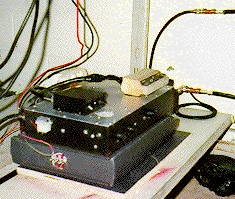
This is largely a 'homebrew' repeater...The first picture on the right is the repeater receiver and linking hardware. The 10 meter receiver is a converted Hygain CB with a homebrew I.F. discriminator for FM detection and an ARR bipolar RX preamp. 2 additional stages of ceramic I.F. passband filters were installed to improve selectivity. A pulse-type I.F. noise blanker was built and installed, and this was a big help at our sometimes noisy site. Coaxial stubs were cut and installed in the feedline to eliminate interference from local high-powered 27 mhz operations, and can be seen as the coiled cables in the far right of the top picture. The discriminator output is amplified about 10 db and fed into a noise switch and squelch board from a Motorola UHF Micor. I know, as many people have pointed out, it would have been MUCH simpler to grab a low-band commercial rig and make a simple conversion, but improvisation and building are a part of this hobby that I enjoy.


A home brew COS is driven from the noise switch and has about -6db hysteresis. The controller is completely home brew, as is all audio mixing. The ID'r was built from 2 voice storage boards pulled from Hallmark Greeting Cards. The ID'r is in a female (XYL AC4QD) voice during periods
of inactivity, and CW when signals are present on the repeater input. All of the above mentioned hardware is installed in the black enclosure bolted to the top of the UHF Micor (Micor is the bottom piece in the stack). Note the local volume, local squelch, rptr squelch, and repeat inhibit controls on the 'front' of the enclosure. There is a local speaker grill drilled into the upper cover just in front of the RX preamplifier, and an rx S-meter mounted on the side of the enclosure just below the rx preamplifier. That box is FULL! The controller output is interfaced with a UHF Motorola Micor running about 5 watts output. A pl of 88.5 is encoded on the UHF link tx output during COS activity for linking purposes.
  

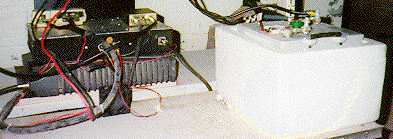
The second photo above is a rear view of the 10 meter repeater receive cluster and linking equipment. A small DC cooling fan is seen as well as the full time battery supply.


The 10 meter receive antenna is a vertically polarized, top-mounted, Antron 99 omni-directional antenna up about 150 feet. The 10m rx site is linked via 70cm to the tx site at about 5 watts power through an eleven element UHF yagi at 60 feet. The link and primary 10m antennas are fed through 75 ohm 1/2" hardline. No matching devices are used, and the match is very good. The uhf-to-hardline connectors are all homemade from plumbing fittings and have worked flawlessly for years. The homemade connectors can be seen in the first photo.


This repeater has a full-time 70cm simplex port, as well as linking capability to the 147.39+ Clayton NC, 147.30+ Wilson NC, and 442.400+ Zebulon NC repeaters. This was an especially challenging project with MAJOR CB interference, powerline noise, birdies on 10 meters from everything in the county, mega-STRONG signals from amateurs working 10 khz off of the input frequency on simplex, etc. It all works well now, so all the effort paid off. 


On the distant end (the TX site), the UHF link signal is received via another UHF Motorola Micor with an ARR GaAsFet RX preamp. In the picture to the right, the Micor is the radio on the left and on the bottom.
The ARR rx preamp has a red sticker and is located just in front of the Micor. The audio is shaped via homebrew mixer and interfaced to the 10 meter exciter. The exciter is another converted Hygain CB with true FM generated by modulating the VCO. The mixer and exciter are housed in the aluminum enclosure bolted to the top of the Micor. The low level RF stages are modified to run full time for stability, and the 1st rf stage after the tx mixer is buffered and keyed to control the final stages of the TX. Much additional heat-sinking was added, and the transistors in the last 3 stages were replaced to improve duty cycle. The exciter produces about 1 watt into a bandpass filter liberated from a RCA series 700 lowband mobile.


The RF then passes through a low-pass filter and into a homebrew solid state intermediate amplifier producing about 15 watts. The intermediate amp is bolted to the top of the aluminum enclosure to the rear, just behind the Motorola remote head. A small muffin fan is attached to it's heatsink for good measure.


The output of this stage is fed into an Ameritron AL80B (hollow-state technology!), driving the 3-500 (at 1700 volts) to about 350 watts output. The beautiful glow of the 3-500 can be seen in the photo to the left. This RF passes through a Drake low-pass filter and up to the 10 meter TX antenna.


The TX site receives the UHF link signal via another eleven element yagi at about 30 feet. The 10 meter TX antenna is an omni-directional Antron 99 antenna at about 150 feet.


Performance for this system was much better than I first expected. Coverage for ground wave 10 watt mobile stations is about 30 miles in all directions, while 100 watt mobiles can work it over 50 miles out. Fixed stations can work it over greater distances, some as far out as 75 miles. I must say I was surprised to find coverage on 10 fm so good. We have a 220 and 440 repeater at the same site, and the 10 meter repeater far exceeds their coverage.


Dave WB4IUY